JENNIFER Q. LU FUNCTIONAL MATERIALS LAB
CONVERGENCE OF 3D POLYMER PRINTING WITH CATALYTICALLY-ASSISTED CARBONIZARION
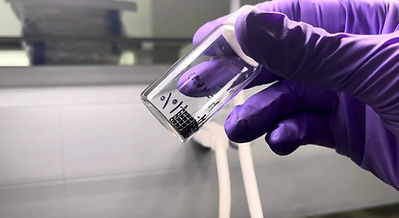
Through catalytically assisted conversion, our patented methodology enables high-throughput fabrication of 3D hierarchical carbon with precise control in macro-, micro-, and nano- scale. These innovative electrodes offer provides low-tortuosity and extremely large surface areas. We are currently working on a proof-of-concept for their application in next-generation energy storage and conversion systems.


3D CERAMIC SINTERING and COMPOSITES
By leveraging the unique interaction of electromagnetic waves with carbon, a layer of ceramic-containing polymer can be grafted onto complex 3D carbon architectures. Through controlled nucleation processes, this approach facilitates the formation of 3D ceramics—either as ceramic coatings on 3D carbon or as freestanding ceramics shaped by carbon templates (patent pending).

Polymer Template
Carbon
CONFORMAL SURFACE GRAFTING
Lu's lab has developed anodic, cathodic, and field-assisted surface heating-induced polymerization techniques. By leveraging coordination, ionic bonding, π–π stacking, and other surface-initiated interactions, the team achieves uniform deposition of diverse materials onto carbon surfaces
HIGH CONTRASY MULTISEGMENTED POLYMERS WITH DIVERSE APPLICATIONS
High-contrast multisegmented polymers that act as surfactants to stabilize carbon nanotubes, enabling the formation of resins for 3D carbon nanotubes. The self-assembled polymer thin films can selectively enhance energy storage performance by facilitating the migration of metal ions such as Li and Zn ions (patent filed).


